Audio language models understand what is said far better than how it
sounds. Closing this gap takes more than data. Detailed acoustic
annotation is costly, labels from stronger models inherit their
errors and limits, and fixed data cannot adapt as the learner
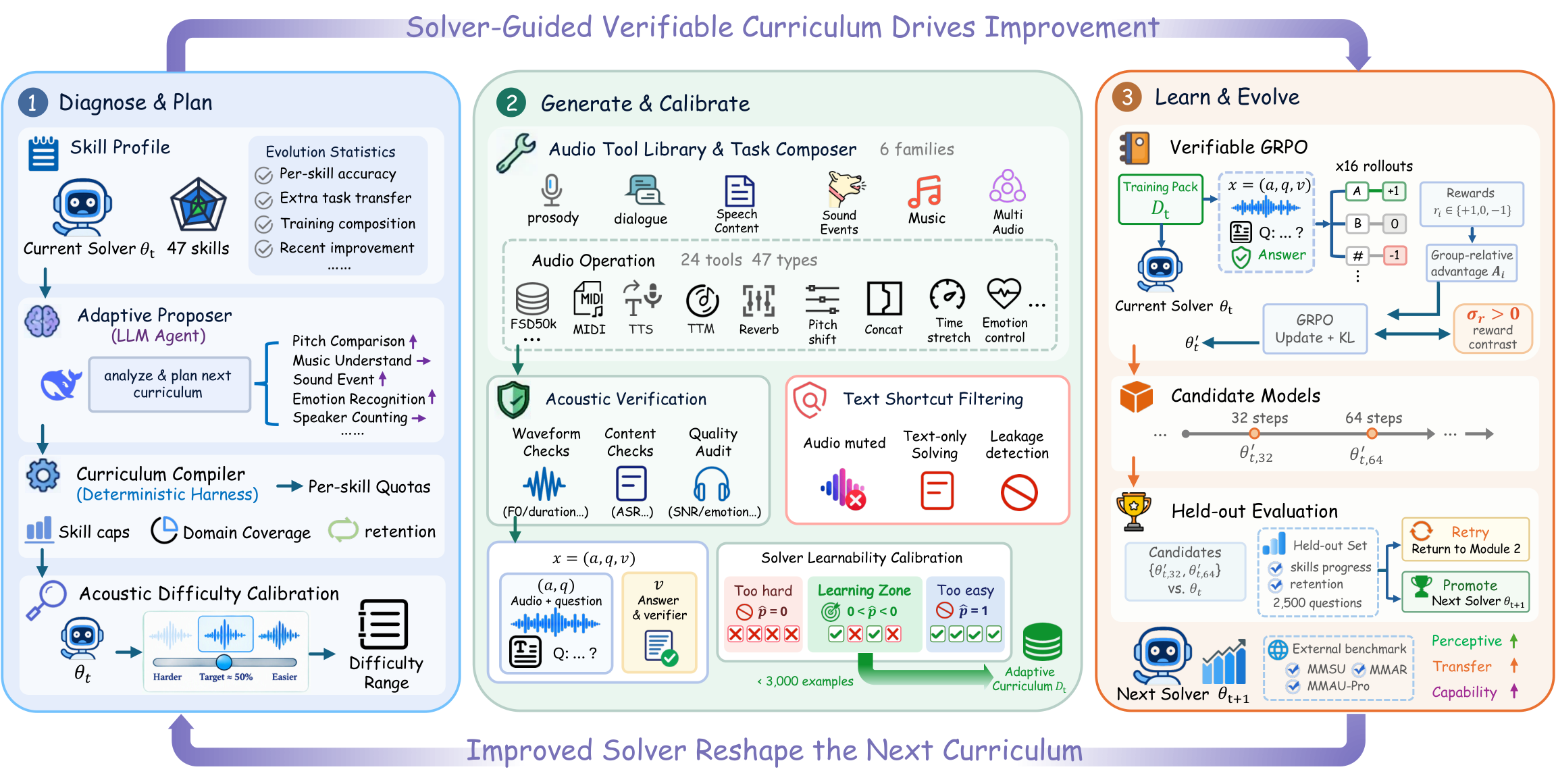
improves. We therefore propose EvoAudio, a
recursive self-improvement system for audio understanding. To our
knowledge, it is the first to evolve the model, waveforms,
questions, and difficulty in one closed loop. EvoAudio uses the
current model's performance to set the focus and difficulty of the
next training data. A library of audio tools then constructs
questions whose answers follow from how the audio was made,
providing verifiable supervision without new human annotation.
Reinforcement learning updates the model, and validation decides
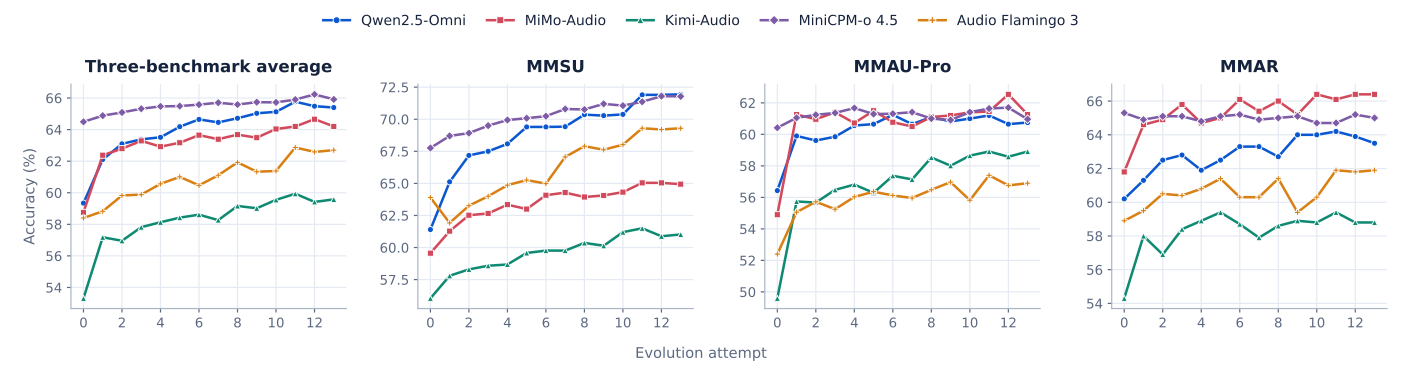
whether it enters the next evolution round. Across 13 rounds,
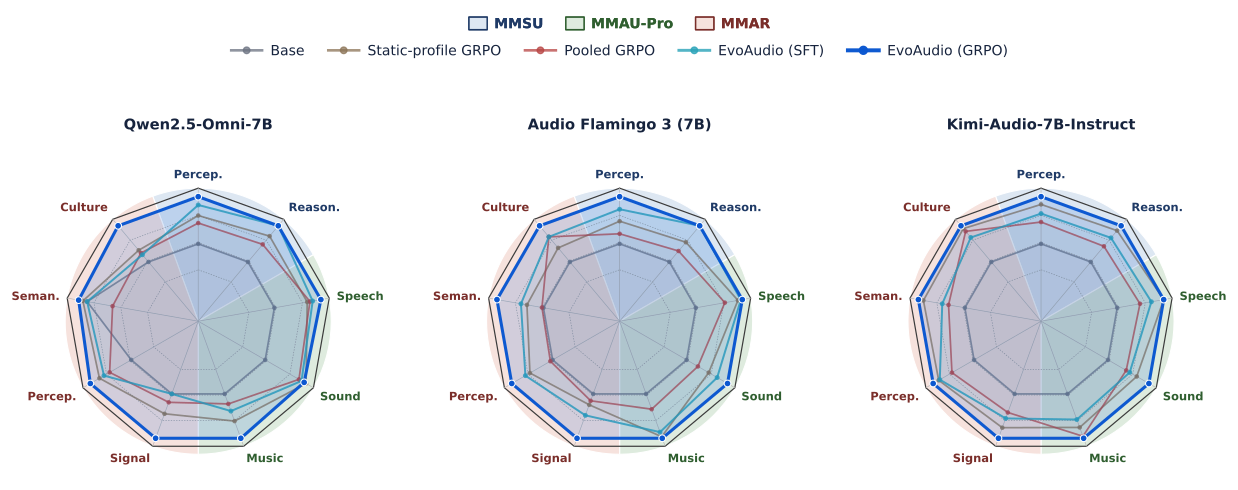
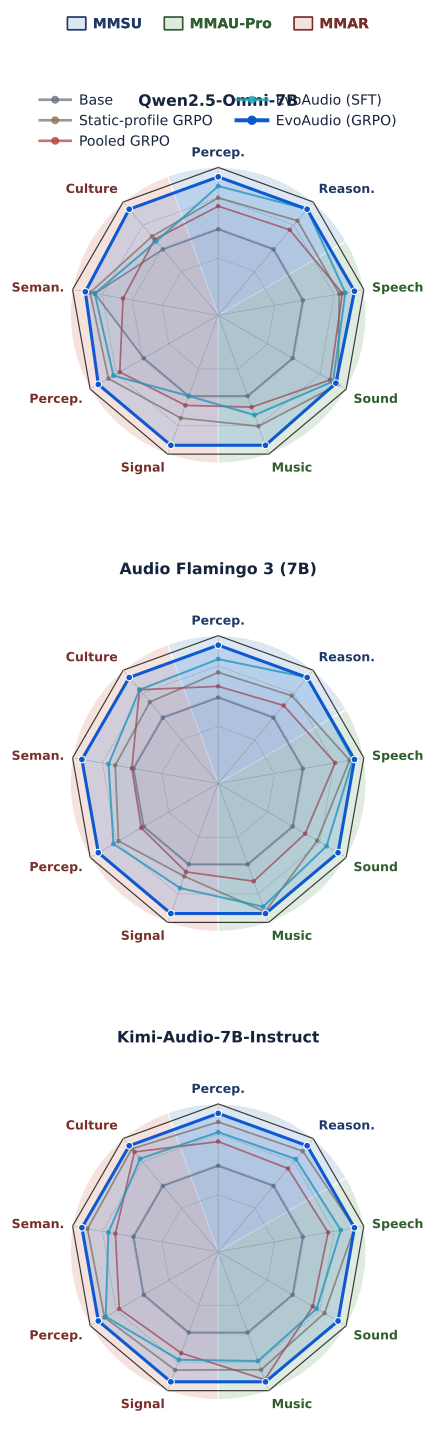
EvoAudio improves five models with different audio encoders and
language backbones on MMSU, MMAU-Pro, and MMAR. It achieves the
highest average for every backbone, raising overall performance by
up to 6.3 points. The improvement unfolds over successive rounds,
with each stronger model starting the next round.